

Georgian Real Estate Market in 2025–2026: Slowdown, Normalization, and Diverging Trends
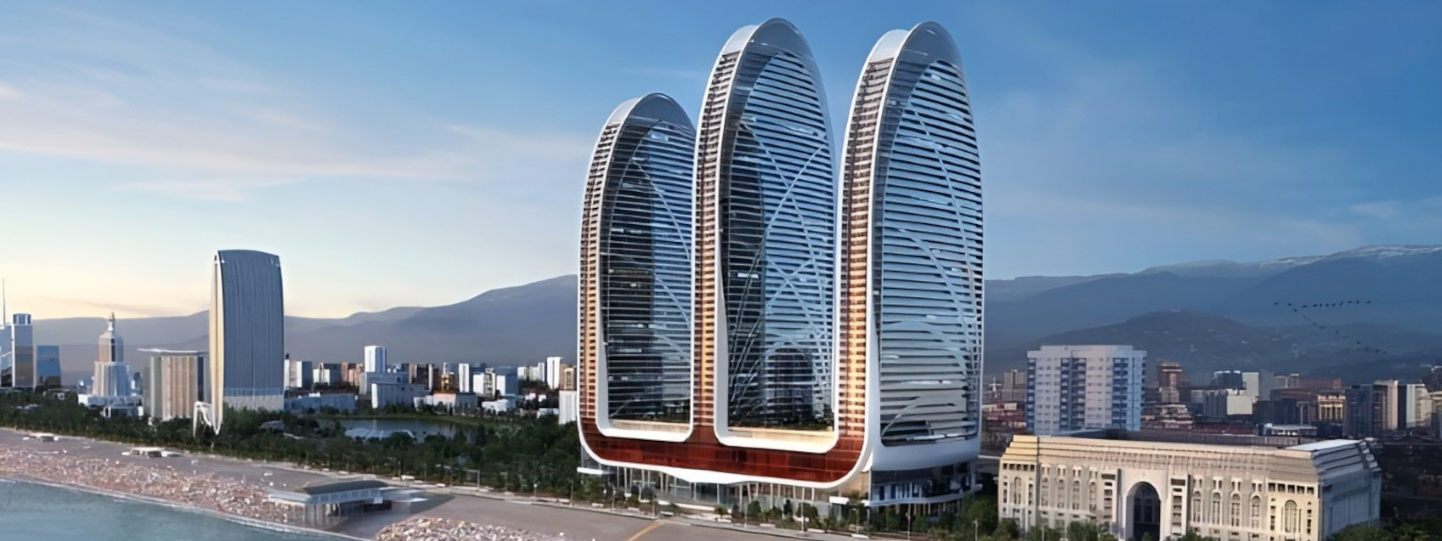
Georgia's residential real estate market has entered a new phase. After several years of overheated demand driven by mass migration, sales prices in the country's largest urban centers have begun to rise more slowly and unevenly. At the same time, asking rents in the capital have started to decline — a clear sign that the market is gradually normalizing.
Regarding housing prices, 2025 showed that growth continues, but without the previous momentum. According to Georgia's National Statistics Office (Geostat), the Residential Property Price Index for new properties in Tbilisi rose by 3.27% year-on-year in the fourth quarter of 2025. However, inflation was slightly higher, resulting in a real decline of 0.67%. Apartment prices increased by 3.47%, while detached house prices rose by 2.55%, also implying slight real declines.
The National Bank of Georgia attributes the earlier price surge to strong economic activity and migration-related demand in 2022–2024. The current slowdown, in the regulator's view, reflects cooling economic growth and a normalization of demand conditions. Easing pressure on construction costs and a high volume of permit issuances in recent years have also played a role.
Within Tbilisi, prices vary significantly. Apartments are most expensive in the prestigious districts of Mtatsminda and Vake, where median asking prices per square meter reached $2,497 and $2,176, respectively. The lowest prices are in Samgori ($1,315) and Gldani ($1,383). Interestingly, annual apartment price growth remained positive across all districts of the capital, meaning upward pressure remained relatively broad-based. The picture for detached houses was more mixed, indicating a less uniform market.
The situation is different in Batumi. According to consultancy Galt & Taggart, the average price for primary-market turnkey apartments reached $1,865 per square meter in 2025, up 9.4% year-on-year. Old Batumi remains the most expensive submarket at $3,028 per square meter. However, analysts warn that price growth in the primary segment is outpacing demand. The number of unsold apartments is rising, and large-scale new construction plans have not yet been fully absorbed, meaning supply clearly exceeds current consumption.
Overall, 2025 showed that the market is still expanding, but no longer as rapidly or universally. Tbilisi has entered a more balanced pricing phase, while Batumi continues to show stronger growth, albeit with clear signs of supply-demand imbalance. Forecasts for 2026 are modest: Tbilisi is expected to see price growth of around 3.2% (TBC Capital forecast), while Batumi is projected to grow by no more than 4–6% (Galt & Taggart forecast).
As for demand, the market remained resilient, though without previous intensity. In 2025, 78,500 apartments were sold across Georgia — 5.94% more than the previous year. The secondary market (63% of all transactions) grew faster than the primary market: 7.42% versus 3.53%. This suggests that people are still actively buying homes, but the frenzy has subsided, and the market is normalizing.
In Tbilisi, 42,388 apartments were sold during the year — up 4.31% from the previous year. The start of 2025 was weak, and analysts even feared a correction, but demand later recovered thanks to pent-up purchases. Domestic buyers remain the backbone of the capital's market, accounting for about 77% of primary sales. The largest foreign buyer groups are from Israel (about 10%) and Russia (about 3%).
Batumi recorded noticeably stronger momentum: 17,478 apartments sold, a 15.02% year-on-year increase. There, demand was fueled both by large new project launches and by stronger resale activity — the larger the stock of completed homes, the more opportunities for resale. Foreigners play a much more significant role in Batumi, accounting for 52% of sales in surveyed projects. The buyer mix is also more diverse: 13% each from EU countries and Israel, and 11% from Ukraine, Russia, and Belarus combined.
In 2026, analysts expect further stabilization. TBC Capital forecasts growth in apartment sales nationwide of 1.4–2%, depending on the development of the Middle East conflict. In Tbilisi, demand is expected to remain at 2025 levels, while in Batumi, primary sales are likely to remain flat, but secondary sales may continue to rise.
Housing supply in 2025 also remained substantial, although the number of completed and permitted projects declined slightly. A total of 2,112 residential projects were completed — 5.38% fewer than in 2024. However, the total completed residential area increased by 1.65% to 2.468 million square meters. This means fewer but larger projects. A similar pattern was seen with construction permits: 8,167 permits were issued (–3.23% year-on-year), while the permitted area barely changed, totaling 8.816 million square meters. This indicates that future supply remains high. In Tbilisi, according to Galt & Taggart, permit issuance is still 32% above the "healthy" average level of 2015–2022. The market is not yet suffering from an oversupply of completed housing, but competitive pressure from the pipeline of permitted projects remains high.
Georgia's rental market, according to the 2014 census, covers only about 4% of households. Rental inflation, after the migration surge of 2022–2023, has stabilized at low levels. In March 2026, the annual increase in actual rents was just 1.9%, while overall inflation reached 4.3%. In nominal terms, the average rent for a 50–60 sqm apartment in Tbilisi in February 2026 was $10.1 per square meter. The highest rents are in Vake ($13.8), Mtatsminda and Saburtalo ($11.7 each), and the lowest in Samgori and Gldani ($8.4 each). At the same time, asking rents in the capital continue to decline: they fell by 8% in 2024 and 11% in 2025. In the first two months of 2026, the average rent was $10.0 per square meter, 6% lower than a year earlier. Gross rental yields have also returned to the historical norm of around 8%: in February 2026, the average for Georgia was 7.42% (7.53% in Tbilisi, 7.31% in Batumi). TBC Capital forecasts a further 2.1% decline in rental rates in the capital in 2026.
Mortgage lending continues to grow, although rates remain high and are not falling in line with the National Bank's policy rate. The policy rate has been frozen at 8.0% since May 2024. The weighted average interest rate on new mortgage loans in national currency in February 2026 was 12.14% (higher than a year earlier), while in foreign currency it was about 8.01%. Despite expensive credit, lending volumes are rising: in 2025, banks issued new mortgage loans totaling GEL 9.6 billion (about $3.5 billion). However, growth slowed to 9.1%, compared to double-digit rates in the previous two years. Nearly 70% of new loans were in lari. The total mortgage portfolio reached GEL 24.2 billion ($9.1 billion), increasing by 16.2% over the year. If mortgages amounted to 11.8% of GDP in 2015, by 2025 they had reached 23%.
Finally, economic and social conditions: Georgia's economy posted impressive growth — 7.5% in 2025 following 9.7% in 2024. However, the World Bank and IMF forecast a slowdown: 5.0–5.3% growth in 2026 and 5.0–5.5% in 2027. The reason is uncertainty stemming from the Middle East conflict, geopolitical tensions, and trade fragmentation. Inflation in March 2026 was 4.3% (averaging 3.9% for 2025), and it is likely to remain elevated in the first half of 2026 due to higher imported food and oil prices. The World Bank forecasts inflation of 5.0% in 2026, followed by 3.8% and 3.0%.
The labor market has improved, but problems remain: few quality jobs, and employment is concentrated in agriculture and the informal sector. The unemployment rate in the fourth quarter of 2025 was 13.3% — a two-decade low, but still high, especially among youth.
In November 2025, Fitch Ratings affirmed Georgia's rating at 'BB', revising the outlook from negative to stable — thanks to increased international reserves, a reduced current account deficit, and solid growth prospects. In February 2026, S&P Global Ratings also affirmed the 'BB' rating with a stable outlook.
Nevertheless, Georgia's economy remains vulnerable to external shocks, including deteriorating relations with the European Union, domestic political polarization, and slow progress on structural reforms.

Need Support?
© 2006-2026 Rielt.org.